This page may contain affiliate links which may allow us to collect a commission when you click and make a purchase through the links on our site. There is no additional cost to you for doing so.
Title: Jane Austen Tarot
Written by: Diane Wilkes
Art by: Lola Airaghi
Publisher: Lo Scarabeo
Price: $28.95
Number of cards: 78
Card size: in
Box size: 2 in approx
Guidebook pages: 126 (56 in english)
Purchased or gifted?: review copy gifted by Llewellyn Books
Absolute favorite card: Justine
Other favorites: (in order from most beloved): The Hermit, Ace of Quills, 4 of Coins, Death, 7 of Cups, The Devil, 4 of Quills
Notable detail:
Season: Spring
Sabbat: Beltane
Sign: Air
Element: Cancer
Deck compliment: Kate Forsyth’s Fairytale Oracle
Collective Pull: The Fool

Some of my favorites
First Impressions
In truth, this is not really my style. It reminds me of comic book art and I’ve never been a comic book fan. Not that I find anything wrong with them—they’ve just never been something I’ve gravitated towards. What I do love is a British period drama, any period drama really but I love British tv. I subscribe to all of the Brit channels: Brit Box, Acorn TV, Masterpiece classic, BBC Select and more (I’m currently watching and loving the Other Bennet Sister at the time of writing this.. So as you could imagine, a Jane Austen tarot is one I couldn’t resist, whatever the style might be.
On a first pass, I can admit that I don’t love the art but that doesn’t mean I won’t like the deck. I have reviewed many, many decks that I didn’t love style wise only to love working with them so this one might be the same. So let’s take a closer look and, be sure to let me know if this is one you’ll be adding to your altar.
The Packaging
This is your standard box by that I mean, nothing special about it. It’s a 2 piece box with a pretty basic print on the top and the bottom of the box. One thing to note is the lack of thumb arches making it challenging to pull the top off of the bottom. It’s also not the sturdiest box ever but certainly enough to hold the cards if kept well.
The print is matte on the box as well as the cards. It has just a touch of sheen to it but it doesn’t have too much of a glare if any at all. The cards are also pretty standard to Lo Scarabeo at least. They aren’t super thick but definitely couldn’t be called thick either. Having said, they shuffle well although mine are starting to develop a bit of a curve. These cards are not gilded and I find myself annoyed by this yet again.
I know this is a small thing in the grand scheme of decks and gilded edges or lack thereof won’t impact your cards accuracy at all. It’s more about the experience and the fact that many publishers are stepping up with things like this. Not to mention, this deck of cards is $28.95 and there’s absolutely nothing special about it. Whereas there are decks that retail for the same amount OR LESS that have foil, gilded edges, better boxes, bigger guidebooks and more. If I had to choose whether I was going to spend my hard earned money on this or a deck with all of the goodies, where do you think I’d put my money? That’s right…door number 2.
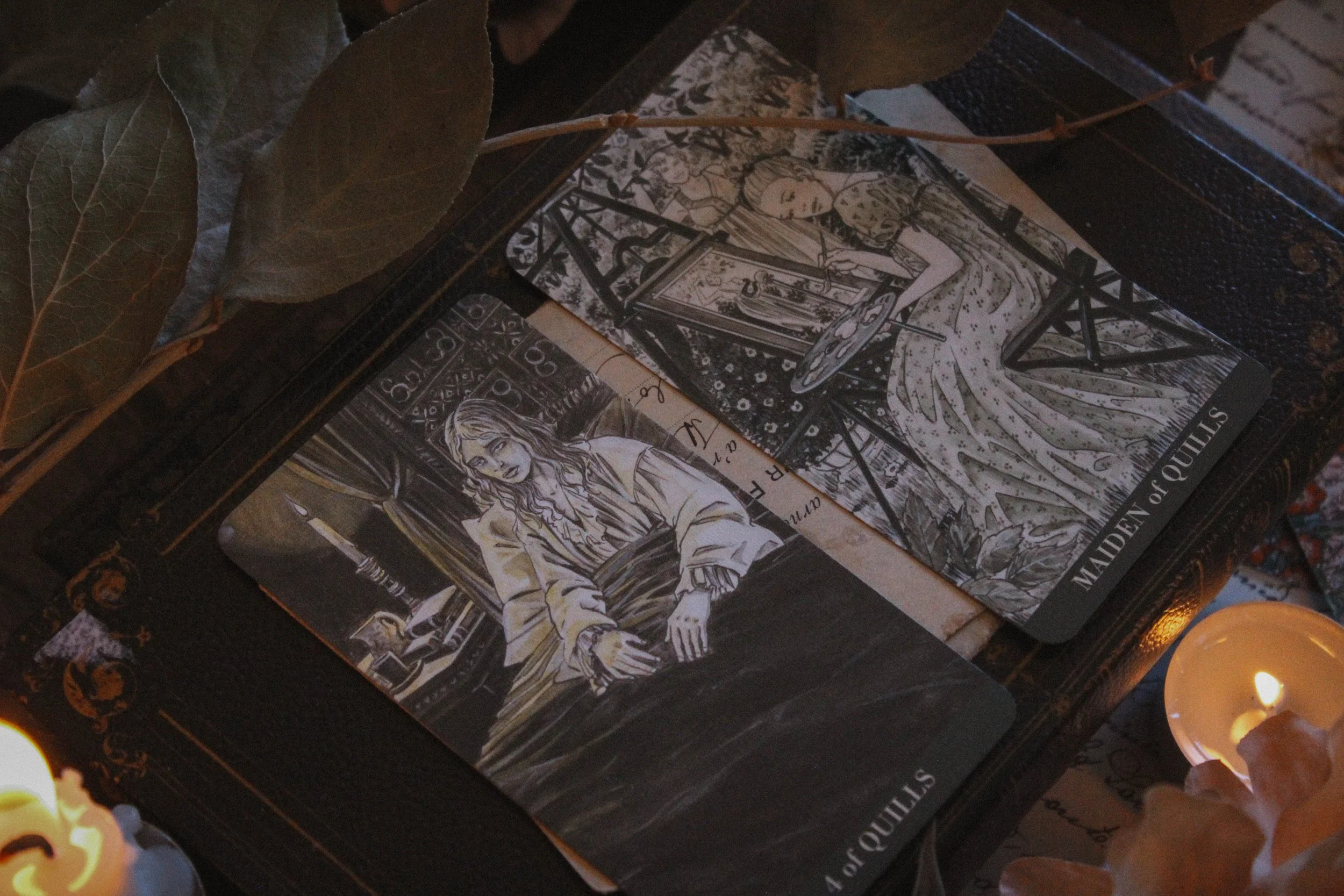
Four of Quills & Maiden of Quills
The Guidebook
The guidebook is also pretty standard for Lo Scarabeo. It’s small, black and white, and features four separate languages to choose from. Inside the guidebook, you will find:
An introduction
Why the creator wanted to make the deck
Two spreads
Card meanings
Perhaps my favorite part of the guidebook is the association with a different Jane Austen novel for each of the cards. This is done for both the major and minor arcana. I think real life examples really help readers to better understand tarot. Working with tarot can be immensely abstract, making it challenging to understand how to adapt a card to your unique situation. Having a reference to various novels provides more context than just the card meaning on its own. If you’re familiar with any of Austen’s novels, you might be able to connect dots that have otherwise gone unnoticed.
Aside from that though, this is your standard issue guidebook. You have the bare bones so just enough to get started. I’m a vocal critic of limited guidebooks but I also like to challenge my own perceptions and lately, I’ve been thinking about tarot decks from years ago. For so long, all you got was the little white book and that was enough. So it's not that a smaller book isn’t enough to get you started. It's just that tarot has expanded so much in the past decade. New understandings of tarot have emerged and I think it’s become too complicated to have such a small book now.
Theme
The theme is quite obvious of course as it’s based on Jane Austen. But the creator goes on to say tarot and Austen’s books share a focus on balance in everyday life. I don’t know its balance so much as just the complicated nature of the human being. Each story, whether fictional or not, has a variety of characters and personalities, just like the tarot.
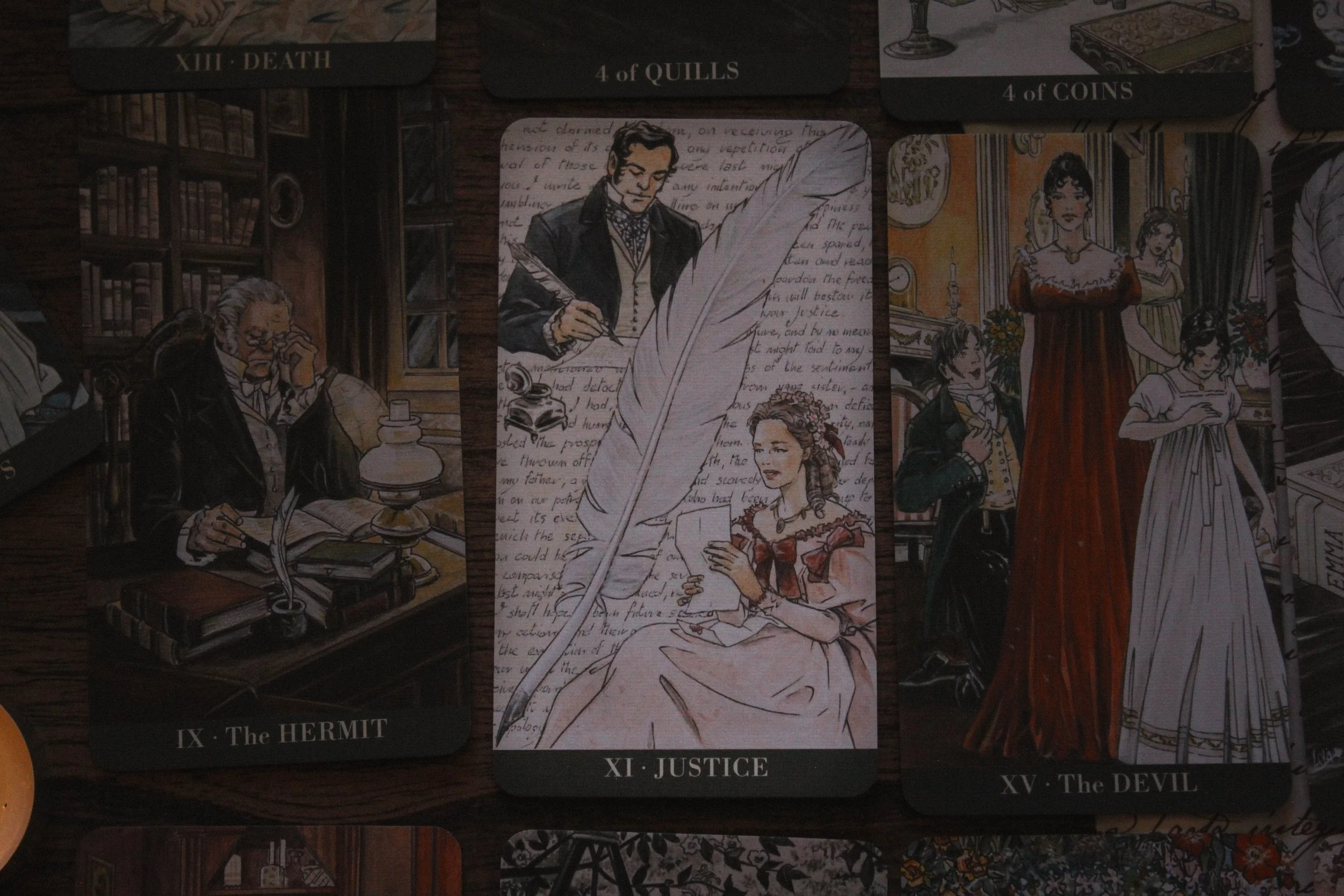
My favorite card
The Artwork
The artwork reminds me of comic books. Now, full disclosure, I don’t read comics and I never have. So when I say this reminds me of comic books, I simply mean this is the association that I have. You might not agree with that and it might not be completely accurate but that’s where my mind goes. Having said that, I did find out that the artist is actually a comic book artist so, seems my association is correct.
It also reminds me of Kate Forsyth’s Fairytale Oracle which is also the deck I chose for the companion but more on that later. One thing you might notice here is the lack of color. It’s not that the deck isn’t colorful because it is but it's very subdued. Many of the cards are white and dark green but done in a way that they almost look black and white. The maiden and nine of quills is a great example. But you do have pops of yellow, red, pink and brighter greens throughout.
“Jane Austen Tarot’s Book and deck are based on the commonality Austen’s oeuvre and the Tarot share—that of recognizing the benefit of equipoise and balance in our lives.”
There is also an obvious lack of diversity here. Now one can argue that diversity wasn’t a thing during this era which is true. However, I think of Bridgerton and how they didn’t let that stop from featuring a variety of people. I know a lot of people are feeling over the diversity conversation but the lack of diversity in decks like this is why people continue to push the issue. Anyway, my point is that if diversity is important to you, then know you won’t find that here.
Reading With this Deck
So you know that this is not an oracle in the true sense so I’ve been very careful to work with it the way it’s been intended. I don’t like using it like an oracle but I do love using it to intuitively find a spell. I asked “which spell represents me best” and I was satisfied with my answer. I felt like it hit the right note.
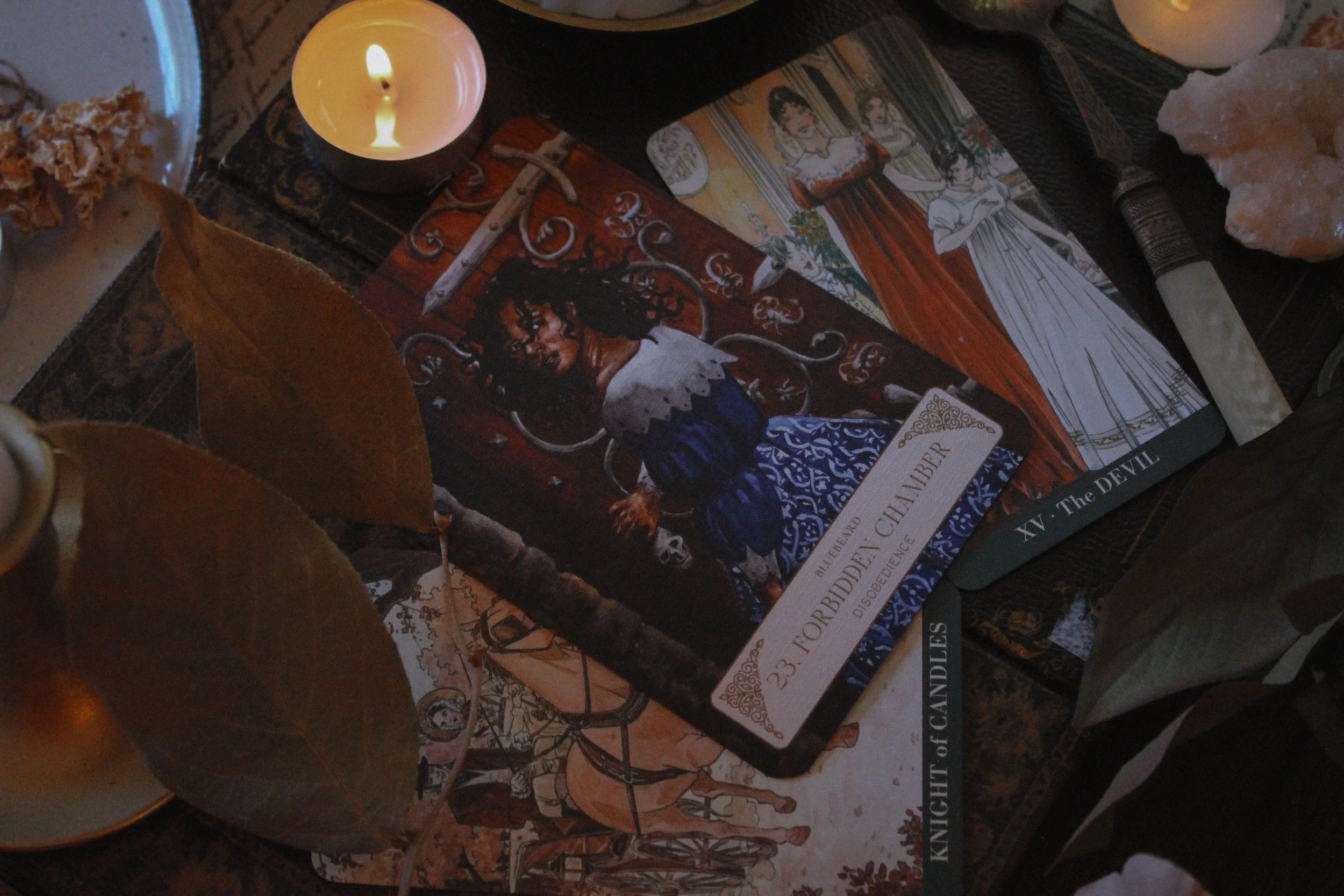
With companion deck
Season, Sign, Element and Sabbat
I chose spring for the deck as a lot of the art appears to be set in a spring like landscape. I also tend to think of spring when I think of Jane Austen. I think of rose bushes and walks in the park, both of which are featured quite heavily throughout this deck.
I went with air for the element because of all of the writing details. You see quills and paper and people reading books. Tarot in itself is associated with the air element because divination is a type of communication. But you really see physical methods of communication throughout the book which naturally made me think of Gemini and the air element.
I went with Cancer for the zodiac sign though. There’s just a soft quality about this deck that feels more feminine and nourishing than Gemini. I also kind of think of a person at home, curled up on a soft chair reading a romance novel. That feels like a Cancer activity. That sense of being at home and just enjoying your own company. I could also make the argument for Pisces seeing as getting lost in fantasy is a Pisces thing but I think the energy overall feels more like Cancer.
Finally, I chose Beltane. Romance and passion are Beltane all day long. This deck isn’t overtly passionate but the components of romance are there. There’s connection, desire, creativity and even a bit of anger. All things that slot nicely into Beltane’s energy.

Collective Pull
Collective Pull
I pulled The Fool for you. The Fool arrives in the moment of a sacred beginning. It’s easy to view this card as a moment of recklessness but its truth is a moment of a sacred beginning. A reminder that all true transformation begins with a leap into the unknown, no matter how foolish it might appear to those on the outside. We often romanticize the idea of new starts, but the Fool’s lesson is far deeper than naïve optimism. It’s the courage to unclench your grip on what you think you know, to meet life without pretense, and to trust that the unseen path will rise to meet you when you step forward.
Collectively, this card calls you to loosen your attachment to certainty. The world is shifting, and many of us are being asked to start over — in identity, in purpose, or in belief. The Fool invites you to see this not as a loss, but as liberation. To walk forward with open eyes and a soft heart, even if your knees are trembling with fear.
This is an initiation into trust — not blind faith, but embodied wonder. It’s the willingness to let curiosity lead again, to rediscover the magic in things that no longer dazzled you, and to risk being changed by what you find. The Fool reminds you that wisdom is not born from caution, but from movement. Will you step forward? Don’t wait to have the map. Be the mapmaker.
Who is this deck for?
To me, this is a fan deck. If you like the idea of having a tarot to match your Jane Austen obsession then go ahead and get it. There are no bells and whistles… It's just a standard tarot deck that’s wrapped up with a pretty theme. And there’s absolutely nothing wrong with that. Every deck doesn’t need to reinvent the wheel. If you just want a solid deck to have and the look or theme of it aligns with your energy then I’m sure you’ll enjoy it.
Deck Companion
I chose Kate Forsyth’s Fairytale Oracle. The style of the cards, although not exactly the same, really remind me of one another. But I also think the Fairytale Oracle shares the romantic energy of a Jane Austen novel. There’s whimsy and softness to both decks. Fairytale Oracle is much more colorful and bright which I think helps to uplift the somewhat drab quality of the Jane Austen Tarot. But ultimately, I think their themes are very similar in the sense that they are based on fictional stories that help us transport to idyllic places. Stories that allow us to get lost in the hope of love, connection and happy endings.

Guidebook
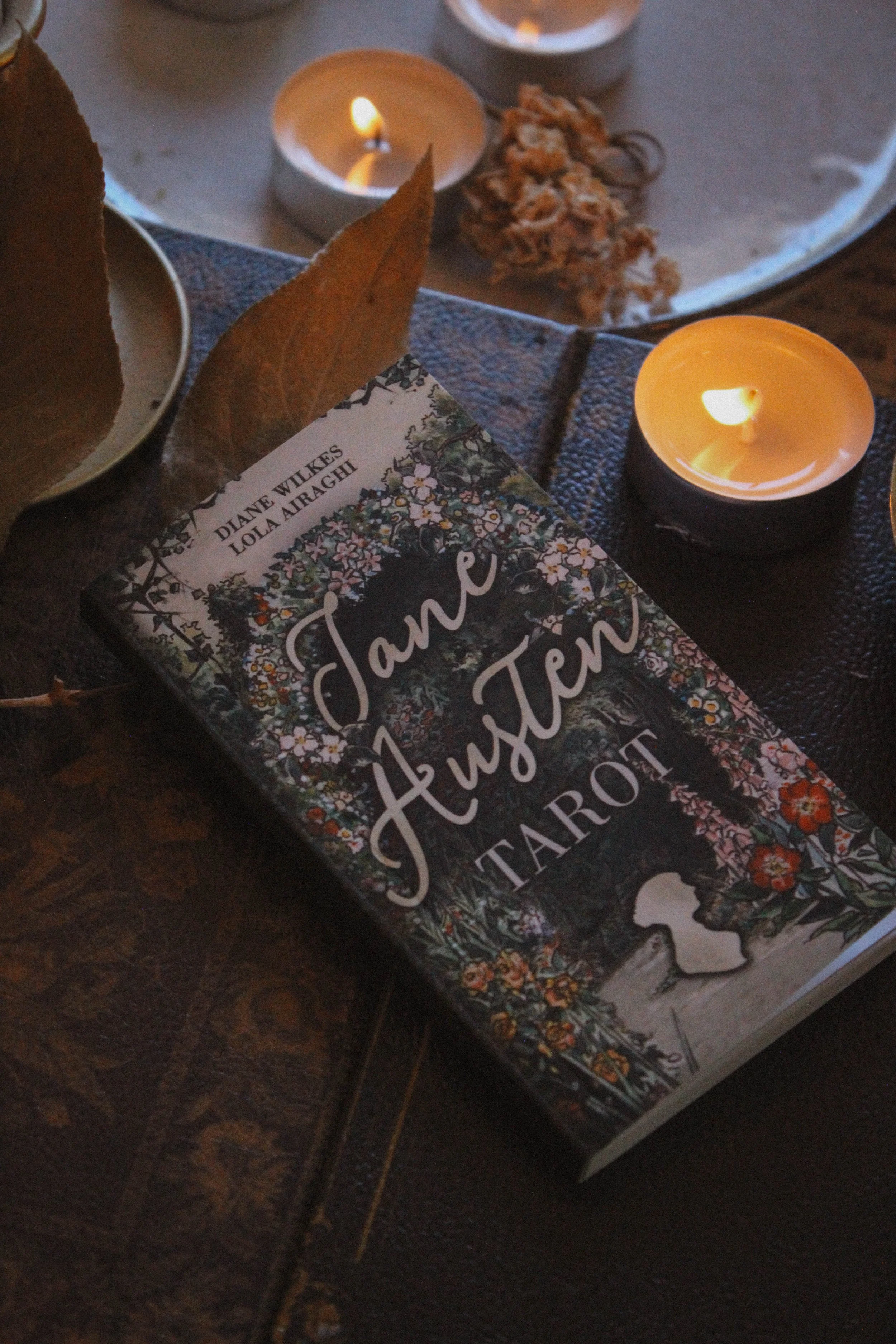


Box